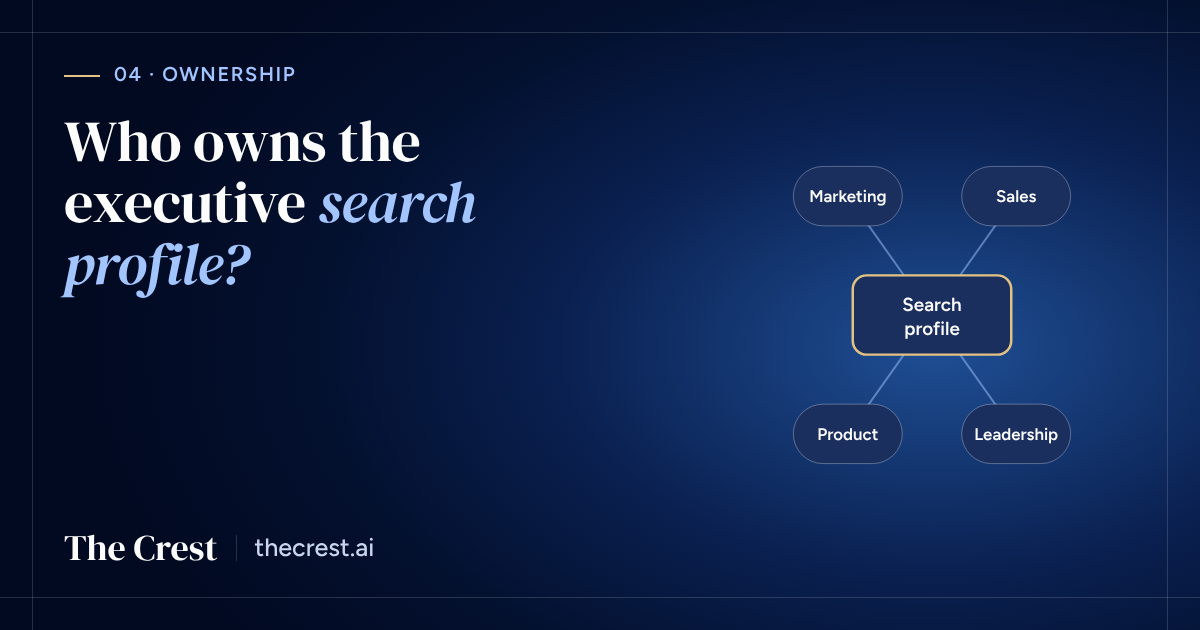
In many companies, the CEO’s online presence sits with whoever runs the website or the press office. That made sense when search meant a list of links and a few press mentions. As we set out in Why Executives Must Control Their Search Profile in the Age of AI, it no longer covers the whole picture. Executive visibility in AI answers affects far more of the business than marketing, so ownership has to cross teams.
Who is affected
When an AI assistant describes your leadership team, it is doing a job for several parts of the company at once.
- Sales. Buyers research the leadership team before a large contract. An inaccurate or thin description of the people in charge can slow a deal down or raise questions late in the process.
- Hiring. Senior candidates ask what the leaders are like and what the company stands for. The answer shapes who applies.
- Investors and partners. Early due diligence often starts with an AI summary, long before anyone opens a data room.
- Communications. Journalists use assistants for quick background. Whatever the assistant says is what they bring to the interview.
- Customer service. After a problem, some customers look up who runs the company. A fair, accurate description helps keep a complaint in proportion.
The pillar article puts it simply: AI search presence is not solely a marketing initiative. It touches marketing, sales, product, customer service and executive leadership.
Why “everyone” usually means “no one”
Because the profile matters to many teams, it often belongs to none of them. Marketing updates the website. Investor relations updates the annual report. HR updates the careers page. The executive updates their own professional profile when they remember to. Nobody looks at the whole picture, and nobody checks what AI actually says.
The result is drift: small inconsistencies that build up until an assistant describes the wrong role, the wrong company or a story from five years ago.
A simple ownership model
You do not need a new department. You need one accountable owner, a short routine and clear rules about what only the executive can decide.
One accountable owner
Name one person who is accountable for the executive’s search profile. In most organisations this sits naturally in communications or in the office of the chief of staff. Their job is not to do everything, but to make sure it gets done.
A monthly review
Once a month, the owner shares a one-page summary:
- The current presence score and how it has moved (see Presence Score: A KPI for Executive Reputation).
- The main changes in what AI assistants say.
- A short list of fixes, each with an owner and a date.
Shared inputs from other teams
Sales, HR and investor relations each tell the owner when they hear how the executive is being described outside the company. Those signals are often the first warning of a problem.
Clear rules for sensitive changes
Decide in advance who approves what. Factual updates to pages the company controls can usually be handled by the owner. Anything involving legal issues, past controversies or third-party publications should go to the executive and, where needed, to legal counsel.
What the executive personally needs to do
Very little, but it has to be them:
- Approve the core facts once: name, title, short biography and photo.
- Review the monthly summary, which should take ten minutes.
- Say yes to a few chosen opportunities each quarter: an interview, an article under their name, a conference talk.
Everything else can be run by the team. The executive’s involvement matters because only they can confirm facts and lend their voice to new content, and because AI systems give extra weight to what a person says in their own name.
Making it stick
The model works when it is boring: same prompts, same report, same day each month. It fails when it depends on a crisis to get attention. Treat the executive search profile like any other important asset: owned, measured and reviewed.
The monthly review will quickly surface specific problems: missing facts, out-of-date roles, topics where competitors are cited and you are not. Read on: Finding Gaps in What AI Says About You.
Key takeaways
- Executive visibility in AI answers affects sales, hiring, investors, communications and customer service.
- Shared importance often means no clear owner, which leads to drift.
- Name one accountable owner, run a monthly review and agree approval rules for sensitive changes.
- The executive’s part is small but essential: approve the facts, read the summary, say yes to a few opportunities.