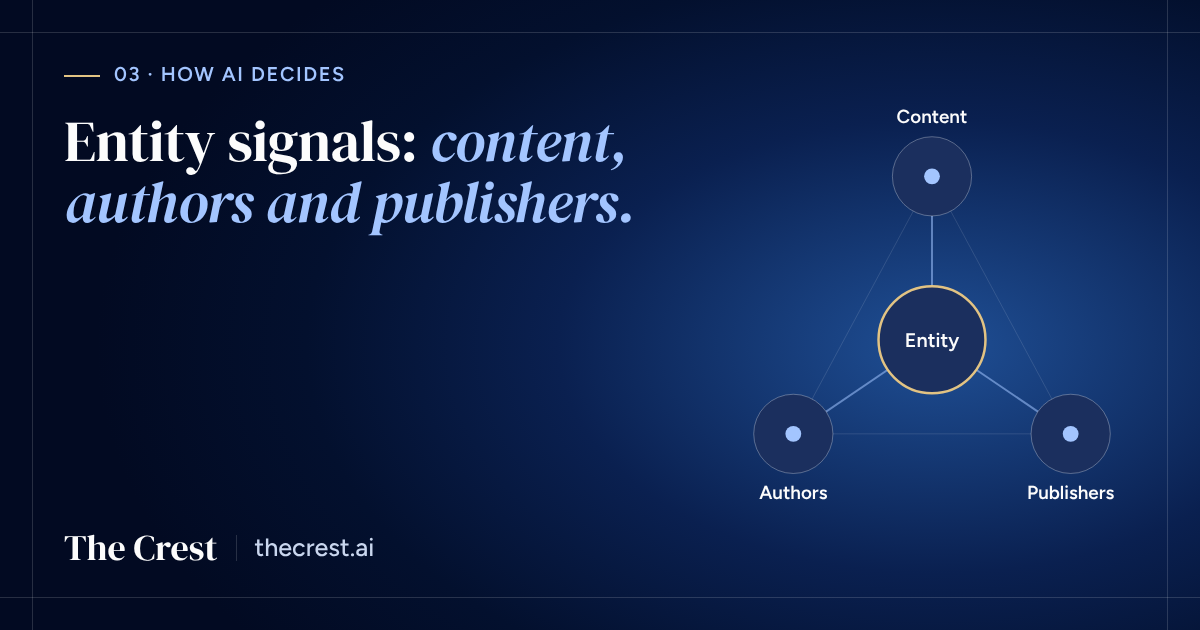
When someone asks an AI assistant about you, it does not simply look for pages that contain your name. It tries to work out which person you are, what is reliably known about you, and which sources it can trust to say so. In Why Executives Must Control Their Search Profile in the Age of AI we described these as entity-level signals: content, authors and publishers. This article explains what that means in practice, without the jargon.
What an “entity” is
Search engines and AI models increasingly organise information around entities: a specific person, a specific company, a specific role, a specific place, all linked together. Google’s Knowledge Graph is the best-known example. When it is confident about who you are, you may see a knowledge panel next to search results. AI assistants use similar connected knowledge when they write an answer.
Entity SEO is the work of making it easy for these systems to recognise you correctly and to connect you with the right facts. For an executive, the goal is simple: when someone asks about you, the system should know exactly which person they mean and describe you accurately.
The three signals
1. Content
Clear, factual pages that state who you are, what you do and what you have done, in plain language. The best examples are a leadership page on your company’s website, a well-maintained professional profile and an up-to-date biography used for speaking engagements.
What helps:
- Short, direct statements of fact: “[Name] is the Chief Operating Officer of [Company], based in [City].”
- Dates for roles and achievements, so the system can tell current from past.
- Structured data on your own pages (for example schema.org Person markup), which states the same facts in a machine-readable form.
What hurts: vague marketing language, missing dates, and biographies that have not been updated since a previous role.
2. Authors
Articles, posts and interviews published under your own name build a consistent author identity. Over time, they tell AI systems what you know about and which topics you can be cited on.
What helps:
- Writing regularly on a small number of topics you genuinely know.
- Using the same name, photo and short biography on every byline.
- Linking author pages back to your main profile.
This is also how executives begin to appear in answers about their field, not only about their name. That is where much of the business value sits.
3. Publishers
Where content appears matters. A respected trade publication, a well-known conference site or your own company’s official website usually carries more weight than an anonymous blog or a low-quality directory. The pillar article frames this as part of what AI systems use to decide trustworthiness, and it matches what most practitioners see: a single profile on a trusted site can change answers that a dozen weak pages could not.
Consistency is the multiplier
The three signals only work if they agree. If your title is different on your company site, your professional profile and a conference page, an AI has to guess which one is right. Sometimes it guesses wrong. Sometimes it mixes you up with someone else entirely.
If the same facts appear in the same words across trusted sources, it does not have to guess. That is why consistency often matters more than volume. Ten new articles will not fix a profile whose basic facts disagree.
The core facts to align everywhere:
- Full name, spelled the same way.
- Current title and company.
- Location.
- A two to three sentence biography.
- A recent, professional photo.
A practical check you can do this week
- List every page that describes you and that you can edit or influence.
- Put the core facts side by side in a simple table.
- Mark every mismatch.
- Fix the pages you control first, then ask for corrections on the rest.
It is the cheapest reputation work there is, and it often changes AI answers faster than new content does.
Who should own this work
Keeping these signals aligned is not a one-off job. Roles change, companies announce news, and old pages drift out of date. Someone has to own it. Read on: Who Owns the Executive Search Profile?
Key takeaways
- AI systems describe people as entities, linked to companies, roles and facts.
- Three signals carry weight: clear content, a consistent author identity, and trusted publishers.
- Consistency across sources matters more than volume.
- Start by aligning your core facts on every page you control.