Once you start collecting AI answers about yourself on a regular schedule, patterns appear. In Why Executives Must Control Their Search Profile in the Age of AI we noted that presence-score data can reveal content gaps, perception issues and even market opportunities. This is where reputation monitoring pays off. The score tells you how you are doing. The gaps tell you what to do next.
Four kinds of gap
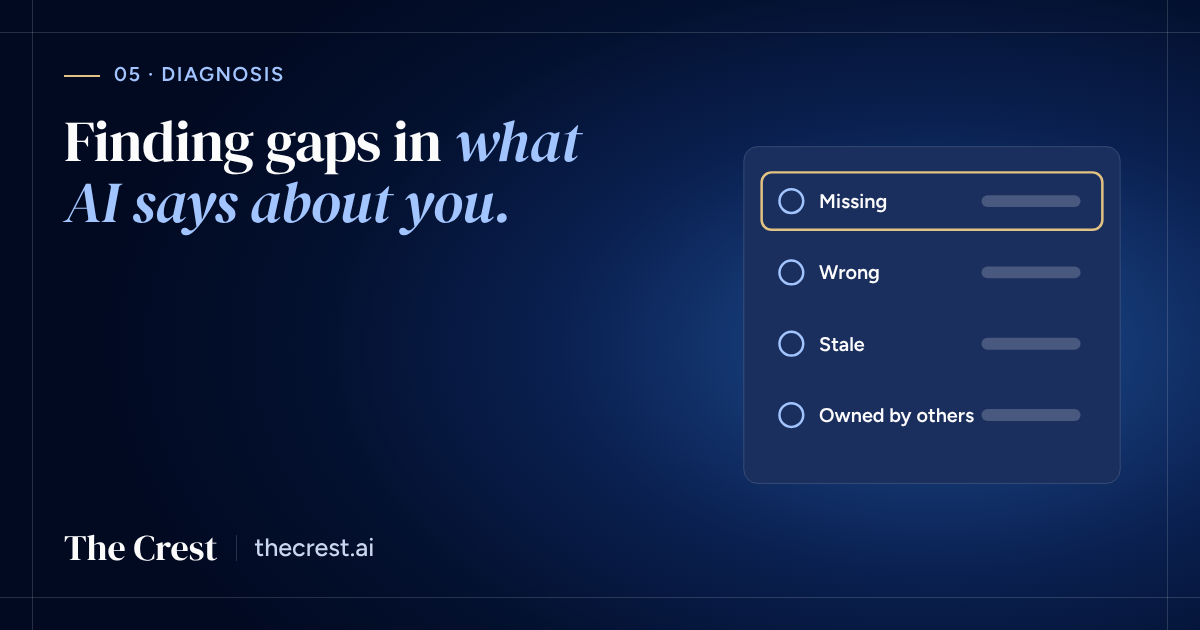
Most findings fall into one of four groups. Sorting them this way makes it much easier to decide what to do.
1. Missing facts
An important role, achievement or area of expertise never appears in the answers. Typical examples: a board seat, a major project you led, a degree, or the fact that you founded the company.
Why it happens: the fact is not stated clearly on any source the AI trusts, or it is buried in a long page where it is easy to miss.
What to do: publish or update one clear, citable page that states the fact plainly, with a date. Your company’s leadership page or your main professional profile is usually the right place.
2. Stale facts
An old job title, a former employer or a finished project is still described as current.
Why it happens: older sources outnumber newer ones, or the newer sources do not include dates.
What to do: update every source you control so it shows the current role with a start date. Ask for corrections on third-party pages that are out of date. Add new, dated content that confirms the current position.
3. Wrong context
You are mixed up with someone who shares your name, or a single old story dominates every answer.
Why it happens: the AI cannot tell which person is which, or one source is far stronger than anything else about you.
What to do: for name confusion, make your identity unmistakable: the same full name, photo, title and short biography on every main profile, with links between them. We explain why this works in Entity Signals: Content, Authors and Publishers. For a dominant old story, the lasting answer is usually not to fight it but to add newer, stronger, accurate sources so that it becomes one part of the picture rather than the whole of it.
4. Topic gaps
When people ask about your field rather than your name, others are cited and you are not.
Why it happens: you have expertise, but little of it is published under your own name in places the AI reads.
What to do: write and speak on a small number of topics you genuinely know. Publish under your own name, in places people in your field already read. Answer the questions people actually ask.
Turn each gap into one action
For every gap you find, write down:
- What the AI says now (or what it leaves out).
- What it should say, in one sentence.
- The source that would make it true: which page, which publisher.
- Who owns the fix and by when.
Keep the list short. Three well-chosen fixes a month are better than twenty that never happen. If the profile has a clear owner, as described in Who Owns the Executive Search Profile?, this list becomes the core of the monthly review.
Gaps are also opportunities
The pillar article makes a point that is easy to overlook: presence-score data can highlight underserved segments and market opportunities, not only problems.
When you track topic prompts over time, you often find questions in your field that nobody answers well. An executive who answers them clearly, under their own name, can become the source AI cites. That is reputation work and business development at the same time. It also tends to be more motivating for the executive than fixing old errors.
A note on what not to do
Some gaps are tempting to close quickly with low-quality content: thin profile pages on obscure directories, or pages that repeat your name without saying anything useful. These rarely help and can make things worse, because they add noise to the signals AI systems use. Accurate, well-sourced and genuinely useful content is the only approach that lasts.
Bring it together in 30 days
Spotting gaps is the diagnosis. The next step is a short, structured plan to act on them and measure the result. Read on: A 30-Day Plan to Take Control of Your Search Profile.
Key takeaways
- Most findings fall into four gaps: missing facts, stale facts, wrong context and topic gaps.
- Each gap has a typical cause and a typical fix.
- Turn every gap into one action with an owner and a date, and keep the list short.
- Topic gaps are also opportunities to become the source AI cites in your field.