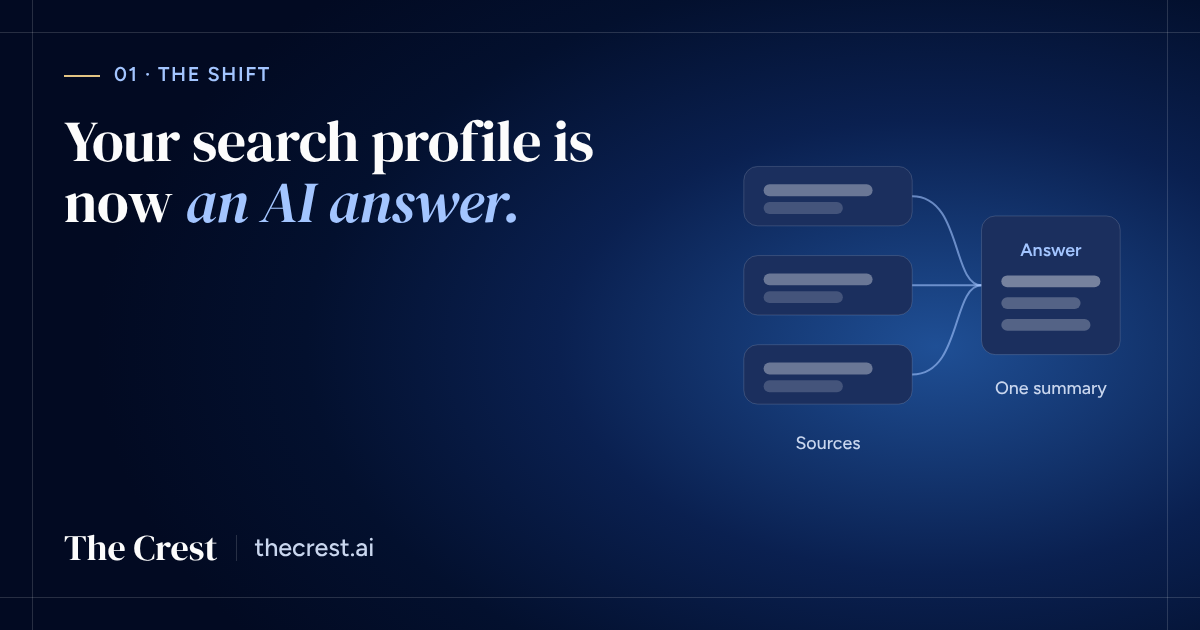
For most of the last twenty years, an executive’s reputation online meant one thing: the first page of Google for their name. You could see it, screenshot it and work on it one result at a time. As we argued in Why Executives Must Control Their Search Profile in the Age of AI, that picture has changed. A growing share of the people who look you up no longer scan a list of links. They ask an AI assistant, and they get one answer.
That answer is now part of your reputation, and for many people it is the first and only part they see. AI search visibility, meaning whether and how you appear in those answers, has become a leadership issue rather than a technical one.
Who is asking, and what they ask
Think about the people who look up a senior executive in a normal month:
- An investor preparing for a first meeting.
- A journalist who needs two lines of background before a call.
- A senior candidate deciding whether to take the interview.
- A partner’s legal or compliance team running early due diligence.
- A customer who had a bad experience and wants to know who is in charge.
More and more of them type a question into ChatGPT, Gemini, Perplexity, Copilot or the AI summary at the top of Google. They ask things like “Who is [name]?”, “What has [name] achieved?” or “Is [company]’s CEO trustworthy?” The assistant reads a handful of sources and writes a short, confident paragraph.
What changes when the answer is written for them
There is no page two
A search results page shows ten links, and a curious reader may click several. An AI answer usually draws on three to six sources and leaves the rest out entirely. If your strongest, most current material is not among them, it may as well not exist for that reader.
The answer has a tone
A list of links is neutral. A paragraph is not. The assistant chooses which facts to lead with, which to skip and how to frame them. A single old article about a difficult period can set that tone for years if nothing newer and better sourced exists.
Mistakes travel
A wrong job title, an old company, or a mix-up with someone who shares your name can be repeated in every answer, to every person who asks, until the underlying sources change. Unlike a bad search result, the reader often has no easy way to see where the claim came from.
You often cannot see it
Answers differ by tool, by wording and even by day. Nobody on your team sees what an investor saw last Tuesday. Most executives only find out what AI says about them when someone mentions it to them.
What stays the same
AI answers are not invented from nothing. They are built from what already exists on the web: your company’s leadership page, interviews, conference bios, professional profiles, articles you wrote and articles written about you. Search engines and AI systems also rely on knowledge graphs that connect people, companies and roles.
That is good news. It means the work you can do is concrete. Clear, current and well-sourced content about you is still the raw material. The difference is that it now has to be clear enough for a machine to summarise correctly, not only for a person to skim. Facts need to be stated plainly, consistently and in places these systems trust. We look at how they decide what to trust in Entity Signals: Content, Authors and Publishers.
Why this belongs on the leadership agenda
The pillar article makes the point that AI search visibility is cross-functional. It affects sales, hiring, investor relations, partnerships and customer service, not only marketing. When a buyer or a board candidate reads an AI summary of your leadership team, that summary is doing a job your communications team used to do. It deserves the same attention as a press release or an annual report.
It also moves faster. A traditional search result could take months to shift. An AI answer can change within weeks when a strong new source appears, which works both for you and against you.
Where to start this week
You do not need a programme or a vendor to take the first step. Set aside thirty minutes and do this:
- Open three different AI assistants in a private browser window, signed out.
- Ask each one the questions a stranger would ask: who you are, what you have done, and whether you can be trusted.
- Write down each answer, the date, and every source it cites.
- Mark anything that is missing, out of date or simply wrong.
That one exercise usually shows the gap between how you see your reputation and how it is being described to others. The next step is to turn it into something you can track over time, which is what a presence score is for. Read on: Presence Score: A KPI for Executive Reputation.
Key takeaways
- AI assistants now answer “who is this person?” in a single paragraph, drawing on a handful of sources.
- That answer has a tone, can repeat errors, and is mostly invisible to you unless you check.
- It is built from content that already exists, so clear, consistent and current sources are still the lever.
- Start by asking three assistants about yourself and recording what they say and cite.